Monday, February 17, 2020

spring semester current event week 2


Two million Americans still don't have running water, new report says
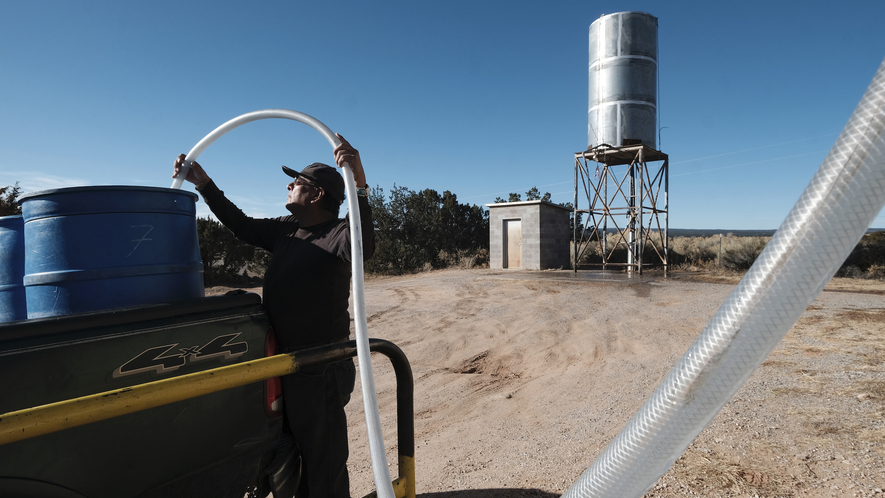

a man fills a bucket with a hose
Image 1. Mose Gibson fills water barrels outside St. Bonaventure Indian Mission and School in Thoreau, a community in the New Mexico portion of the Navajo Nation. Gibson was delivering the water on November 25, 2019, to a relative who does not have running water. Photo: Bonnie Jo Mount/The Washington Post tk
By Frances Stead Sellers, Washington Post
Published:
Word Count:1772
Recommended for:Middle School - High School
Text Level:12
SWEETWATER, Navajo Nation — On a good day, when the breeze is up and Apache County's rutted red-clay roads are passable, Legena Wagner's family drives 45 minutes to fill water containers at a windmill pump. In the days that follow, Wagner dispenses their contents sparingly: half a cup for her 5-year-old to brush his teeth; a couple of pints, well heated, to wash dishes in the decorative enamel bowl on her kitchen table; and about 10 gallons, measured out to last a week, for bathing.
"Running water, it would be such a luxury," Wagner said, pausing to describe how different her life would be if she didn't have to trek outside, past the empty plastic buckets and the rootling pigs, to the outhouse with its majestic views across northeast Arizona's snow-skimmed plateaus.
Wagner is one of more than 2 million Americans who do not have running water and sanitation, according to "Closing the Water Access Gap in the United States." The report, released by two national nonprofit organizations last month, outlines stark, race-based inequalities: Native American households are 19 times more likely than white households to lack indoor plumbing; black people and Latinos are twice as likely.
The disparities also reflect an urban-rural divide. While the lead-contamination crisis in Flint, Michigan, highlighted the perils of aging infrastructure in the nation's cities, rural communities face special challenges, often lacking the economies of scale to upgrade systems and the local expertise to operate them. The situation is so dire in parts of rural America that experts liken it to the developing world.
"The cultures are different, but the experiences are similar," said Brett Gleitsmann, a water supply and sanitation engineer with the Rural Community Assistance Corporation who worked on projects in Africa and south Asia before coming to Native American lands. "Always people are hauling water — from a well, from a relative who has water or a public water station."
The United States does not have a comprehensive means of tracking the number of people living without piped water, according to George McGraw, founder and CEO of the nonprofit DigDeep.
Harder still is to calculate how many people cannot afford water even if they can access it, said Radhika Fox, CEO of the U.S. Water Alliance, a policy-focused nonprofit group that partnered with DigDeep to produce the report.
"That number is much larger than 2 million," she said.
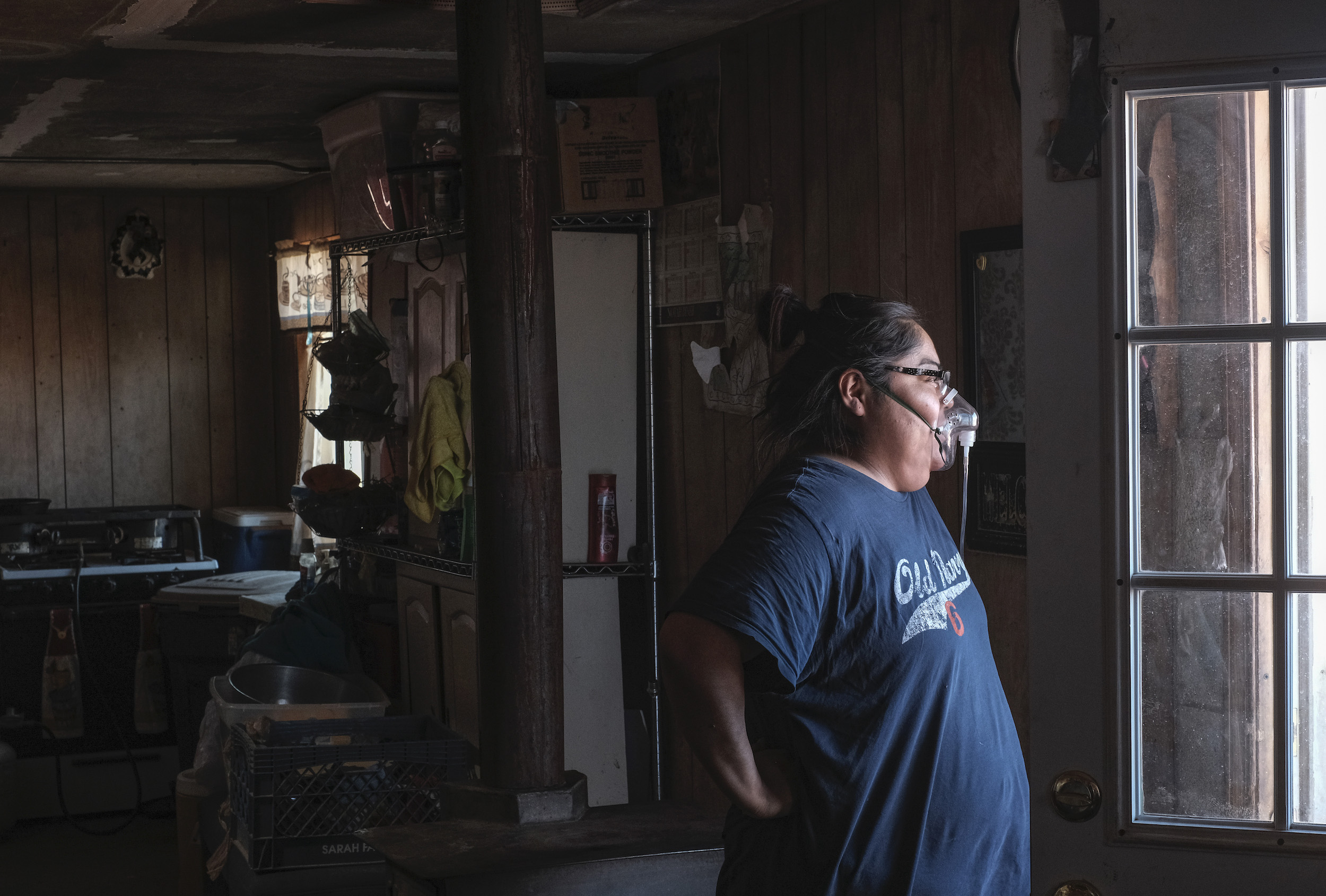
a woman with a breathing mask on looks out a window
Image 2. Legena Wagner stands in her living room in the Sweetwater Chapter of the Navajo Nation on November 26, 2019. Wagner's home, along with about a third of households in the Navajo Nation, does not have plumbing or running water. Photo: Bonnie Jo Mount/Washington Post

The report was produced by collating federal data sets, including 2014 data collected by the U.S. Census Bureau's annual American Community Survey, which asks a small representative sample of residents whether they have running water. DigDeep and the U.S. Water Alliance identified six communities with poor access to running water and wastewater services, including the Navajo Nation, and spent more than a year assessing how residents' lives are affected.
In the Navajo Nation, the country's largest Indian reservation, where water has long been held sacred, about one-third of the population of more than 300,000 does not have a tap or flushing toilet.
"Water is life," the Navajo say. "Tó éí ííńá."
Its cultural importance echoes in the place names — Lake Valley, Whippoorwill Springs, Indian Wells.
Here in Sweetwater, or Tó likon, 15 miles south of Interstate 160 on largely dirt roads, the spring water was known for its bracing mineral taste.
"People couldn't get enough of it," Wagner said. But the springs no longer flow — one of several changes that residents of this drought-prone region attribute to climate change and environmental degradation.
The seeps that used to ooze up before daybreak to refresh grazing sheep and goats have disappeared. Rains that once sustained apricots, corn and squash have been replaced by occasional downpours that race through the empty creek beds. And the winter snows no longer cloak the high desert with the thick, moist blankets Wagner's grandfather recalls.
Those who drive miles to windmills, often carrying matches and wood to light fires below the wells' frozen spigots, may draw water that is not safe. Many water sources across the Navajo Nation are marked with signs warning of contamination, some with naturally occurring toxins such as arsenic, some with uranium and other byproducts of the mining industry.
"A lot of people still drink from those wells," said Jordan Begaye, who had a summer job painting "For livestock use only" on them in red. That's despite extensive public education efforts, according to Yolanda Barney, environmental program manager for the Navajo Nation's Public Water System Supervision Program.
Wagner wonders whether the rare autoimmune disease she suffers from — adult-onset Stills disease — could have been caused by the water, and she now supplements her supplies with bottled water from a grocery store an hour away.
Efforts to bring clean water to remote households have been marked by ambitious aims and setbacks.
Federal funding for water infrastructure has dropped to about one-seventh of what it was in the 1970s after the passage of the Clean Water and Safe Drinking Water acts, which set up partnerships, with the federal government setting national standards for water quality that the states were responsible for implementing. These days, the funding that is available is largely loan-based, requiring repayments that can be crippling for small communities.
The American Water Works Association estimates that maintaining and expanding the country's water systems will cost $1 trillion over the next 25 years. The Indian Health Service has put a price tag of $200 million for providing water and sanitation in the Navajo Nation.
The long-term underinvestment has come under new fire this year. In July, Senator Kamala Harris, Democrat of California, introduced legislation that would plow nearly $220 billion into safe drinking water programs, prioritizing at-risk communities. At last summer's Democratic primary debate in Detroit, Michigan, an hour's drive from Flint, Senator Amy Klobuchar of Minnesota touted her $1 trillion infrastructure plan, which includes water among the country's many failing systems.
In a rare bipartisan move, both the House and Senate recently introduced legislation to establish pilot programs designed to assist low-income residents in paying for water and sewage in much the way they can receive assistance for food and heating oil.
"It's a very new concept," said Nathan Gardner-Andrews, chief advocacy officer for the National Association of Clean Water Agencies, who warned, "It is going to take a while."
That's because political wrangling is only the first step in a process that people here describe as frustratingly slow.
People have their hopes raised by big projects, said Cindy Howe, a longtime community leader who now works as a field operations manager for DigDeep.
"It all sounds so good," she said."But will it happen?"
A giant blue pipe lies in sections alongside Route 491, part of a multimillion-dollar project to bring water from the San Juan River 280 miles south across the Navajo Nation to communities including Gallup, one of the biggest population centers, where groundwater levels have dropped about 200 feet in the past decade.
The project is designed to meet the needs of approximately 250,000 people by the year 2040, according to the U.S. Bureau of Reclamation. But many rural residents doubt it will help them, noting that it can be prohibitively expensive to bring water a few hundred yards from a major pipeline through rocky terrain to an individual home. In the most remote areas, Gleitsmann said, "you might have to run a water line eight miles to two houses."
Those problems are compounded by jurisdictional challenges.
In Teec Nos Pos, at one of the few remaining trading posts, owner John McCulloch described how one elderly woman refused for years to allow water pipes to cross her land. And farther south, in an area known as the Checkerboard, where tribal lands share a boundary with privately owned tracts, and federal and state properties, the differing forms of ownership impede the installation of all kinds of infrastructure, including water pipes and roads.
On a frigid late-November morning, residents began trickling in from isolated homes in the Checkerboard to fill 55-gallon barrels with ice-cold water at the St. Bonaventure Indian Mission and School in Thoreau, New Mexico.
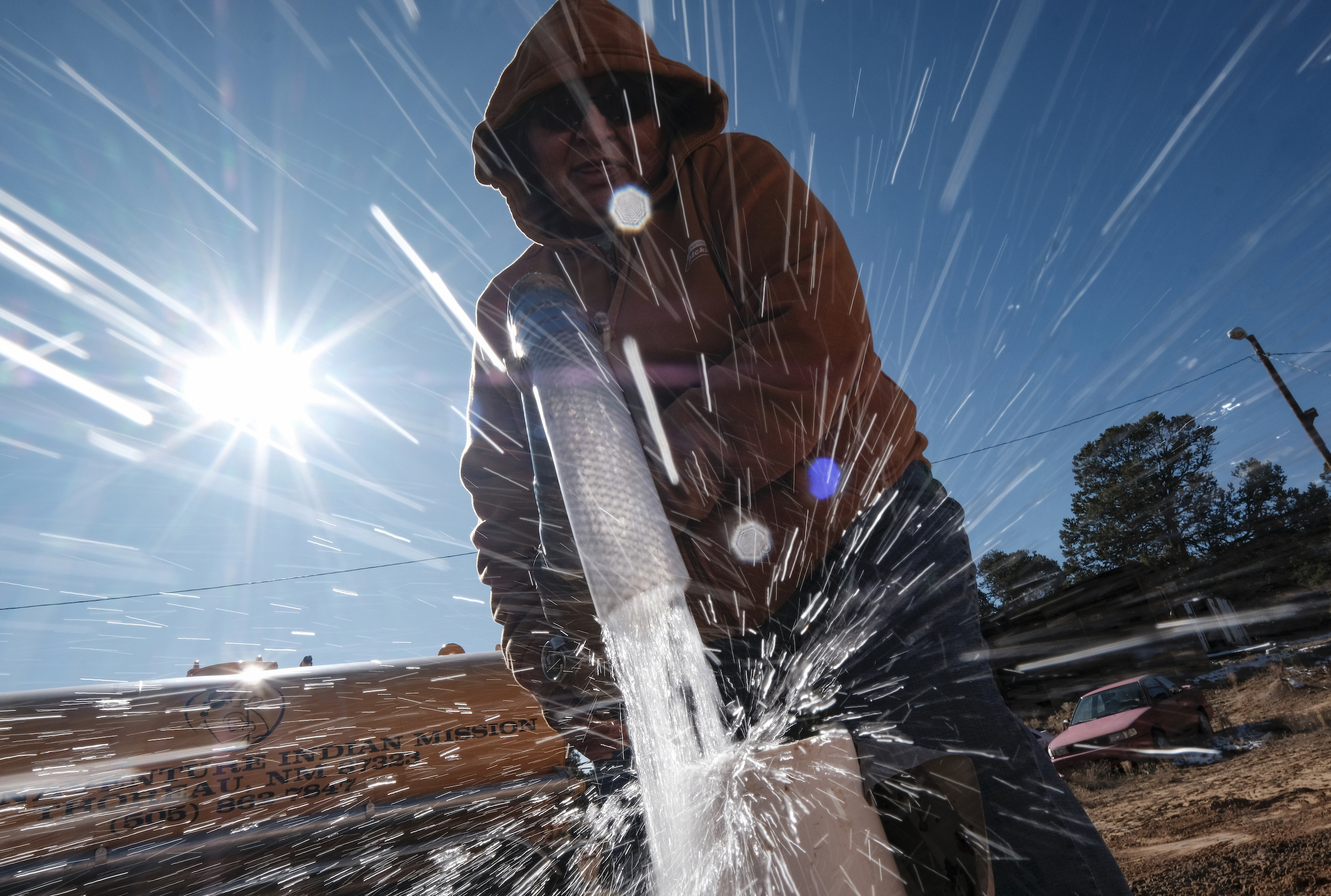
a woman sprays a hose
Image 3. Driver Darlene Arviso fills a 1,200-gallon water tank that was recently installed outside a home in Mariano Lake, a community in the New Mexico portion of the Navajo Nation. Photo: Bonnie Jo Mount/Washington Post

Across the parking lot, DigDeep has an office, stocked with supplies to provide households with a 1,200-gallon tank, a pump, a water heater and a single sink, deep enough to wash a baby. The nonprofit group installs about three of these systems each week, some powered by solar panels in traditional one-room hogans, others in kitchens that seem to be equipped with everything but a functioning faucet.
The nonprofit organization refills the tanks every month, providing about 40 gallons of water a day, less than 15 percent of the quantity used by the average American household.
Henry King, who lives five miles from the nearest asphalt road on land punctuated by pinyon pines and sagebrush, has been hauling water all his life, these days choosing among three public sources, each about 30 miles away.
He never believed the Clean Water Act would do much to benefit people like him, and doesn't hold out much hope for future help from the federal government. The past, he said, is littered with betrayals and broken promises.
"Like water going downhill, it thins out, dries out before it gets to us," he said.
So when King learned from a neighbor about DigDeep, he was eager to help bring a system into his sister's house.
He oversaw the installation, reminiscing about trips by horse-drawn wagon with his parents to collect water from a canyon, until — whoosh! — water sputtered from the brand-new faucet in a small room adjacent to the kitchen.
King smiled. "I can wash my hair," he said with a laugh, throwing off his cap and leaning forward to welcome in the gusher. "Thank you. Thank you. Thank you."
Forty gallons of clean, warm water a day is a luxury Wagner dreams of.
But she also worries about water's growing scarcity and is wary of the way some people come to misuse it. Of how, when they move away to cities, they grow careless with a life-giving resource that her ancestors revered.
"We must not waste it," Wagner said.
"That's how we live. It's who we are."
Reproduced with permission. Copyright © 2019 Washington Post. All rights reserved.

spring semester current event week 2

rump is sending armed tactical forces to arrest immigrants in sanctuary cities

It’s yet another attempt to target sanctuary cities.

US Customs and Border Protection (CBP) agents fire H&K P2000 handguns during a qualification test at a shooting range on February 22, 2018, in Hidalgo, Texas. 
 John Moore/Getty Images

The Trump administration is reportedly sending armed and highly trained law enforcement units to sanctuary cities across the country to support US Immigration and Customs Enforcement in carrying out immigration raids.
As first reported by the New York Times, 100 US Customs and Border Protection officers, including those from the SWAT-like Border Patrol Tactical Unit, will be deployed from February through May across nine sanctuary cities: Chicago, New York, San Francisco, Los Angeles, Atlanta, Houston, Boston, New Orleans, and Newark, NJ.
Border Patrol Tactical Unit agents receive special training for high-risk law enforcement activities, including sniper certification and other advanced weapons training. Their primary charge has been tracking down drug traffickers on the US-Mexico border, where violence can often break out, but now they will also be responsible for conducting routine immigration arrests in some of America’s largest cities, according to the Times.
It’s just the latest instance in which President Donald Trump has sought to target sanctuary cities — which do not allow local law enforcement to share information with ICE or hand over immigrants in their custody — for refusing to cooperate with federal immigration authorities. Immigrants advocates say that the deployment is not only a waste of federal law enforcement resources, it also might endanger immigrant communities.
“This is transparent retaliation against local governments for refusing to do the administration’s bidding,” Naureen Shah, senior policy and advocacy counsel on immigrants’ rights for the American Civil Liberties Union, said in a statement. “It will put lives at risk by further militarizing our streets.”
Department of Homeland Security spokesperson Heather Swift said in a statement Friday that the additional CBP agents (which she emphasized come from a variety backgrounds and not just tactical units) will help overstretched ICE officers deal with the rising number of immigrants who could be arrested on immigration violations but have yet to be detained.
“ICE does not have sufficient resources to effectively manage the sustained increase in non-detained cases which is exacerbated by the rise of sanctuary jurisdictions,” she said. “These officers have also been trained in routine immigration enforcement actions, which is what they have been asked to do.”

It’s all part of Trump’s campaign against sanctuary cities

Friday’s decision is just one in a long line of Trump’s attempts to crack down on sanctuary cities. The administration has tried to withhold federal law enforcement grants from sanctuary states and vacate California’s sanctuary laws (but has mostly failed). And it recently blocked New Yorkers from enrolling in Global Entry and other programs that offer faster processing for pre-vetted travelers in response to new state sanctuary laws.
At his State of the Union address earlier this month, Trump characterized sanctuary cities as a danger to public safety and broadly painted immigrants as violent criminals, highlighting a case of an immigrant arrested on charges of murdering and sexually assaulting a 92-year-old woman in New York City.
Trump has done this over and over during his time in office, turning his ire on international criminal gangs like MS-13 and invoking the stories of “angel moms,” parents of those killed by gang members.
But in reality, research suggests that his characterization doesn’t hold water: Sanctuary policies don’t appear to make a city more dangerous. While there isn’t a huge body of research on sanctuary policies’ impact on crime rates, studies have found that they either slightly decrease crime rates or have no effect.
study published in the journal Urban Affairs Review in 2017 found that cities with similar characteristics but for their sanctuary policies had “no statistically discernible difference” in their rates of violent crime, rape, or property crime. Using data from the National Immigration Law Center and the FBI, researchers compared crime rates before and after cities passed sanctuary laws, finding that they had no effect on crime.
Another study by the Center for American Progress, a left-leaning think tank, examined the almost 2,500 counties that don’t accept requests from US Immigration and Customs Enforcement to detain unauthorized immigrants. The study found that counties with sanctuary policies tend to have lower crime rates than those that don’t: about 35.5 fewer crimes per 10,000 people on average. The counties with the smallest populations exhibited even bigger differences in crime rates.
Many police chiefs say there’s good reason behind those results: Sanctuary policies facilitate better crime reporting and cooperation with law enforcement in criminal investigations.

spring semester current event week 2

Pete Buttigieg replies to Rush Limbaugh’s homophobic comments: “I love my husband”

Limbaugh made homophobic comments about Buttigieg and argued his sexual orientation makes him a weaker candidate.


Pete and Chasten Buttigieg wave to the crowd amid supporters holding up signs.
Former South Bend Mayor Pete Buttigieg and his husband Chasten greet supporters in Iowa in February 2020.
 Win McNamee/Getty Images

Former South Bend, Indiana, Mayor Pete Buttigieg responded Sunday to homophobic comments right-wing radio show host Rush Limbaugh made about him last Wednesday by standing firmly by his marriage.
Limbaugh, who was feted by President Donald Trump at the 2020 State of the Union address, and was awarded the Presidential Medal of Freedom, referred to Buttigieg as “Booty-gieg” on his radio show last week, and offered a bigoted take on how the former mayor’s sexual orientation would affect his chances of winning the presidential nomination. In particular, he questioned what Democratic Party officials might say about Buttigieg.
“‘Okay, how’s this going to look, 37-year-old gay guy kissing his husband on stage next to Mr. Man Donald Trump? What’s going to happen there?’” Limbaugh said. “They’ve got to be saying that despite all the great progress and despite all the great wokeness, and despite all the great ground that’s been covered, America’s still not ready to elect a gay guy kissing his husband on the debate stage president.”
Limbaugh added that Buttigieg would be an ideal rival to Trump, who he said would “have fun” facing off against a politician who “loves kissing his husband on debate stages.”
Buttigieg is the first openly gay candidate to mount a major presidential campaign in American history, and has been married to his husband, Chasten, for over two years.
Sunday, CNN’s Dana Bash asked Buttigieg to respond to the comments on State of the Union.
“Well, I love my husband. I’m faithful to my husband. On stage, we usually just go for a hug, but I love him very much,” Buttigieg said. “And I’m not going to take lectures on family values from the likes of Rush Limbaugh.”

“I love my husband. I’m faithful to my husband,” @petebuttigieg responds to conservative radio host Rush Limbaugh’s recent comments. “I’m not going to take lectures on family values from the likes of Rush Limbaugh.” https://cnn.it/2UR6m94 

And in an appearance appearance on Fox News Sunday, Buttigieg took an opportunity to use Limbaugh’s remarks to take a direct strike at Trump.
“I’m not going to be lectured on family values from the likes of Rush Limbaugh or anybody who supports Donald J. Trump as the moral as well as political leader of the United States,” Buttigieg said.
“America has moved on, and we should have politics of belonging that welcomes everybody,” Buttigieg continued. “That’s what the American people are for. And I am saddened for what the Republican Party has become if they embrace that kind of homophobic rhetoric.”

Limbaugh often makes ugly remarks — these, however, have drawn bipartisan rebuke

Limbaugh’s comments were par for the course with him. Despite being given a civilian honor typically reserved for those who have made positive contributions to American life like Toni Morrison and Ansel Adams, the radio personality has long been a divisive figure who openly peddles racist, sexist, and otherwise inflammatory views.
As Vox’s Laura McGann has explained, “Limbaugh fills hours of airtime each week with hateful commentary directed at African AmericansAsian Americanswomen, people with disabilities, and pretty much anyone who is not white, straight, and male.”
He has mocked the president of China by saying, “Hu Jintao was just going, ‘Ching cha, ching chang cho chow’”; said the NBA should be rebranded “the TBA, the Thug Basketball Association”; and has recently made sexist, ablest attacks on teenaged climate activist Greta Thunberg. And these are just a few of his many, many hateful remarks.
Limbaugh’s remarks are part of why his base tunes into his show, and have not always drawn bipartisan criticism, but his most recent attacks on Buttigieg did just that, with both Republicans and Democrats censuring him.
A spokesperson for Sen. Lamar Alexander, a Republican from Tennessee, said: “There may be reasons not to vote for Mayor Buttigieg, but that’s not one of them. This is a tolerant country.”
“It’s a miscalculation as to where the country is at,” Trump ally and South Carolina Sen. Lindsey Graham said. “I think the country is not going to disqualify somebody because of their sexual orientation.”
Democrats offered stronger condemnation, with former Vice President Joe Biden praising Buttigieg and calling Limbaugh’s language “part of the depravity of this administration.”
Sen. Elizabeth Warren tweeted, “These homophobic attacks against [Buttigieg] are hateful and offensive. ... We will fight together against the hate and bigotry that Donald Trump promotes and rewards.”
And while he did not exactly criticize the man he honored weeks ago, even Trump suggested Limbaugh may have gone too far. When asked during an interview with Geraldo Rivera on Cleveland’s Newsradio WTAM if Americans would vote for a gay man to be president, Trump said, “I think so.”
“I think there would be some that wouldn’t. I wouldn’t be among that group, to be honest with you,” he added.

Week 5

Hello everyone. I hope this week finds you and your family safe and healthy. I know it is getting increasingly more difficult to be home and...